

From Cost Recommendation to Cloud Decision
In this article

A recurring output of Azure cost reviews is a list of unattached managed disks, idle public IPs, empty App Service plans and oversized VMs, each with a monthly number beside it, totalling an amount large enough to justify the review. Six months later, most of that list is usually still there.
This is not a failure of the tooling. The tooling did exactly what it promised: it found the waste and priced it. The reason nothing happened is that somewhere between the report and the change window, a person had to answer a question the report could not answer, and in the absence of an answer the safe move was to leave the disk alone.
The question the list cannot answer
Take one line of it. An unattached premium disk, 512 GB, about €40 a month, last attached to something eight months ago.
Deleting it requires someone to be confident about four things, and a cost platform knows none of them:
Is it protected by a backup policy, and is that policy the only remaining copy of something? A disk that looks orphaned from the billing data may be the restore point somebody is quietly relying on.
Does anything still reference it? Not an attachment, which is visible, but a recovery runbook, an ARM template in a repository, a documented DR procedure.
Who owns it? Not the subscription owner, who owns four hundred other things. The team that would notice at the end of the quarter.
And has anything used it? A disk with no read or write activity for ninety days is a very different proposition from one that was snapshotted last week.
Those four answers are the difference between a decision and a deferral. None of them is in the cost data, because none of them is a billing fact.
Where cost platforms win
Purpose-built cost platforms are better at cost than a general governance tool will be. Saved reports with named filters and folders. Composable dashboards. Anomaly detection trained on months of daily data with noise floors and root-cause attribution. Unit economics tying spend to a business metric. Forecasting with seasonality and confidence bands. Scheduled digests into email and chat.
If your problem is that nobody can see the spend, buy one of those. They solve that problem well, and building an equivalent is a multi-year commitment that mostly produces a worse version of something you could have had on Tuesday.
The gap is not visibility, it is the distance between the list and the change.
The evidence that answers the question already exists
In most organisations the four answers above are already being collected, just not by the thing producing the cost report.
Backup protection state is collected, because someone needed to prove recovery coverage for an audit. Resource-management history is collected, because the Activity Log is retained for compliance reasons, which tells you when the disk was last attached, detached or otherwise changed. Read and write activity is a different source again: Azure Monitor platform metrics hold disk read and write operations, with a retention window of about ninety days unless you export them. Lifecycle and retirement notices are collected, because somebody got burned by a deprecation once. Ownership is the one most organisations have least of, because RBAC tells you who holds permissions rather than who owns the thing, and tags tell you what somebody typed.
All of it describes the same resources as the cost report. It is simply in different tools, with different identifiers, and nobody has joined it.
A recommendation that brings its own governance context reads differently from one that cannot:

That is still a recommendation rather than a decision, and it is one somebody can act on in the meeting instead of taking it away as an action item that becomes a deferral.
The ownership line is the one that takes real work. Permissions are not ownership, and a tag is an assertion rather than a fact, so an authoritative answer has to come from somewhere the organisation actually maintains. That is the part a billing integration cannot infer and the part to build.
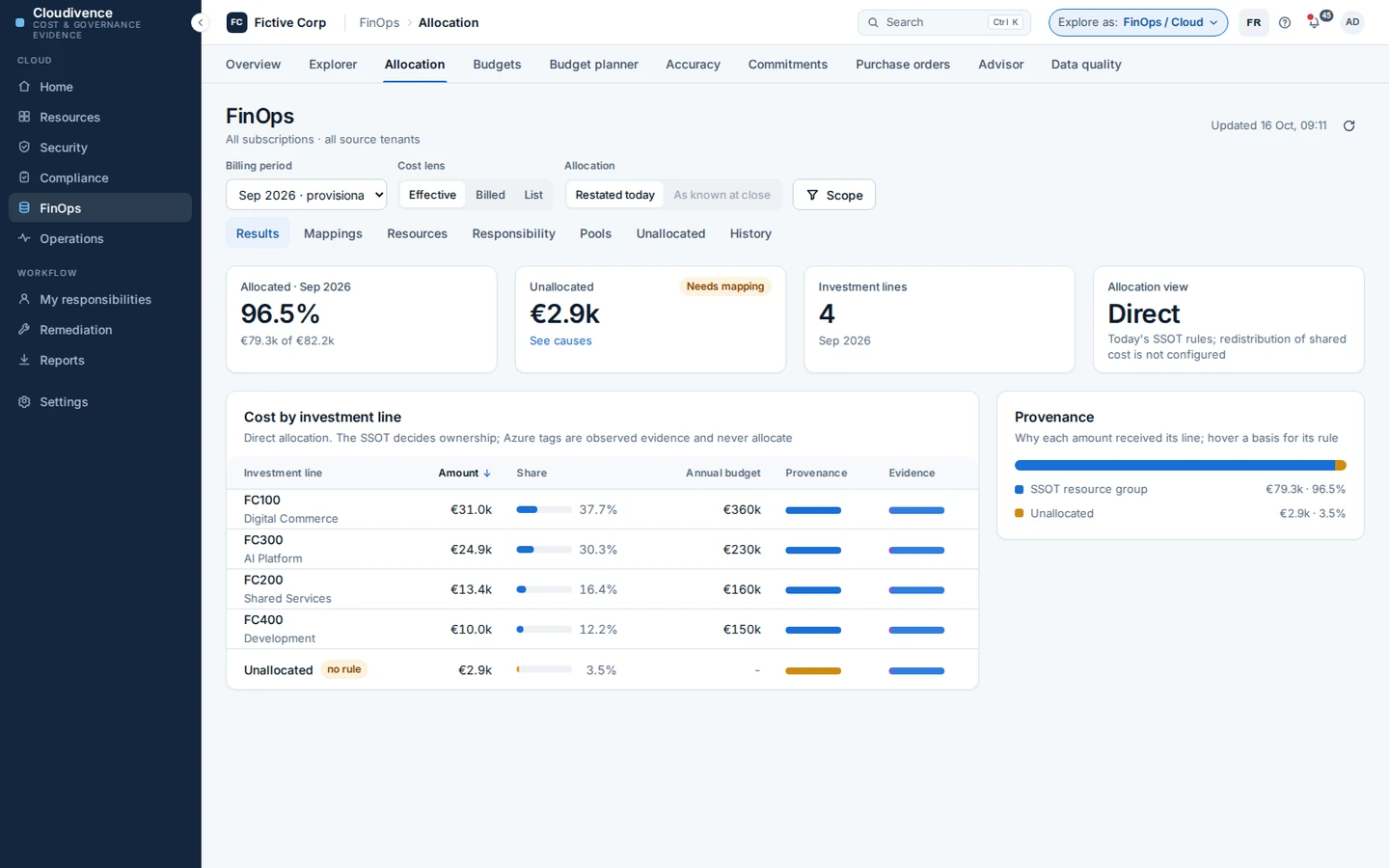
That screenshot is the same argument in product form. The allocation table names the source that decides ownership, shows provenance and evidence per line, and leaves 3.5 percent sitting in an unallocated bucket against no rule rather than forcing it somewhere to make the total look tidy. A gap you can see is worth more than a reconciliation you cannot check.
The CSP wrinkle, which catches a lot of Belgian organisations
One detail worth knowing if you buy Azure through a reseller rather than direct.
Cost platforms integrate with Azure CSP through Partner Center, and Partner Center exposes considerably less than the direct Azure APIs do. In Vantage’s case, the documented consequence is that the CSP integration has neither Active Resources nor Cost Recommendations, because the underlying data is not there to read.
Some billing-channel CSP integrations therefore lose the resource context that optimisation recommendations depend on. In Vantage’s CSP integration specifically, that makes the resource-level capabilities more limited than its direct Azure integration. Anything that combines CSP billing evidence with its own read-only access to the Azure resources closes that gap, because it is no longer asking the billing channel a question the billing channel cannot answer.
Worth checking which side of that line you are on before evaluating anything, because it changes the shortlist.
What this means for buying
A cost platform and an engagement are not competing purchases, and treating them as alternatives is how organisations end up with both a subscription and an unactioned list.
The platform’s job is to produce evidence: what is running, what it costs, who holds it, what protects it, what the risk of removing it is. That is a data-joining problem and software is good at it.
The decision is a different job. Somebody has to look at the disk with the ninety-four-day-old write and decide whether this organisation deletes it, snapshots it first, or leaves it because an application owner is on holiday and the saving is €40. That judgement depends on the organisation’s risk appetite, its change process and its recent history, and no amount of data makes it automatic.
Cloudivence is our attempt at the first part, and the engagement is the second. The first exists to make the second short. It runs against a synthetic tenant in the Fictive Corp demo, so the joined view is something you can open rather than something you have to take on trust. Most of the cost reviews I have run found the real money somewhere other than the obvious list anyway: in log ingestion, egress, orphaned private endpoints and diagnostic settings nobody had looked at, not in the VM sizes everybody had already argued about.
The test to apply
When you are evaluating anything in this space, including ours, the useful question is not which features it has.
Take the last cost report your organisation produced. Find a line nobody actioned. Ask what the person holding it would have needed to know to act in that meeting, and whether the tool in front of you could have put it on the same screen.
If it could, the list gets shorter next quarter. If it could not, you are buying a better-looking version of the report you already ignored.
Cloudivence, formerly Governator
Cloudivence connects Azure cost, ownership and security findings on one evidence model, so every figure and every finding leads to its owner and its source. It runs in assisted pilots.